

Your monthly report shows a profit. Then payroll comes due, a supplier needs payment, and you find yourself checking the bank balance again.
Where did the money go?
It is one of the most common questions I hear from business owners in Murfreesboro and across Middle Tennessee, especially when their companies are growing.
The first thing I want to understand is how the reported profit connects to the change in cash. Profit measures revenue less expenses under your accounting method. Cash flow tracks money entering and leaving the business. The two can move in different directions.
Some of your profit may still be owed to you
Under accrual accounting, revenue is generally recorded when it is earned, which may be before the customer pays. The sale contributes to reported profit while the money remains in accounts receivable.
Your employees and suppliers still need to be paid.
Review more than the total receivable balance. Who owes you money? How old are the invoices? Is anything disputed? When do you realistically expect payment?
If your reports use cash-basis accounting, unpaid invoices generally are not included in reported revenue. Cash shortages can still arise from debt principal, owner distributions, growth commitments, and equipment purchases. How inventory and equipment affect reported profit depends on your accounting treatment.[1]
Growth can require cash before it produces cash
A large contract can be good news and still create a cash problem.
You may need materials, inventory, or additional labor before the customer pays. If you take on several contracts at once, that requirement can grow quickly.
Before committing, ask how much cash the work will require and how long it will be tied up. Where appropriate, discuss deposits or progress billing before work begins. Plan purchases around actual needs and review inventory that is moving slowly.
Include the cash requirement in your growth plan, alongside expected sales and profit.[2]
Some payments reduce cash without reducing current profit
Loan principal payments reduce cash and the loan balance. Principal is not an income statement expense; interest is accounted for separately.
A capitalized equipment purchase also uses cash when you pay for it. Its cost is generally recognized through depreciation over time in the financial statements. Tax treatment may differ.
Owner draws and distributions use cash but generally are not business operating expenses. Keep them separate from wages and other compensation.
These distinctions matter when you are deciding what the business can afford to spend or distribute.
Your bank balance may already be committed
Cash in the account may include sales tax collected from customers or taxes withheld from employee pay that have not yet been remitted. Those amounts should not be treated as available operating cash.
Future tax obligations need a plan as well.
Businesses subject to Tennessee franchise and excise tax generally must make four estimated payments when their liability, after available credits, is at least $5,000 in both the current and prior tax years.[3]
Owners of pass-through entities may also need distributions to fund personal federal estimated tax payments. Those are separate from the business’s own tax obligations, but the planned distributions still affect business cash.
Identify the obligations, expected amounts, and payment dates before deciding what the bank balance allows you to spend.
Connect profit to the change in cash
Consider this simplified, fictional monthly example using accrual accounting. It assumes no changes in payables, no new borrowing, and no other cash movements.
| Item | Effect on cash |
|---|---|
| Net profit | $20,000 |
| Add back noncash depreciation | +$3,000 |
| Increase in accounts receivable | −$12,000 |
| Increase in inventory | −$5,000 |
| Loan principal paid | −$4,000 |
| Cash spent on capitalized equipment | −$6,000 |
| Owner distributions | −$5,000 |
| Change in cash | −$9,000 |
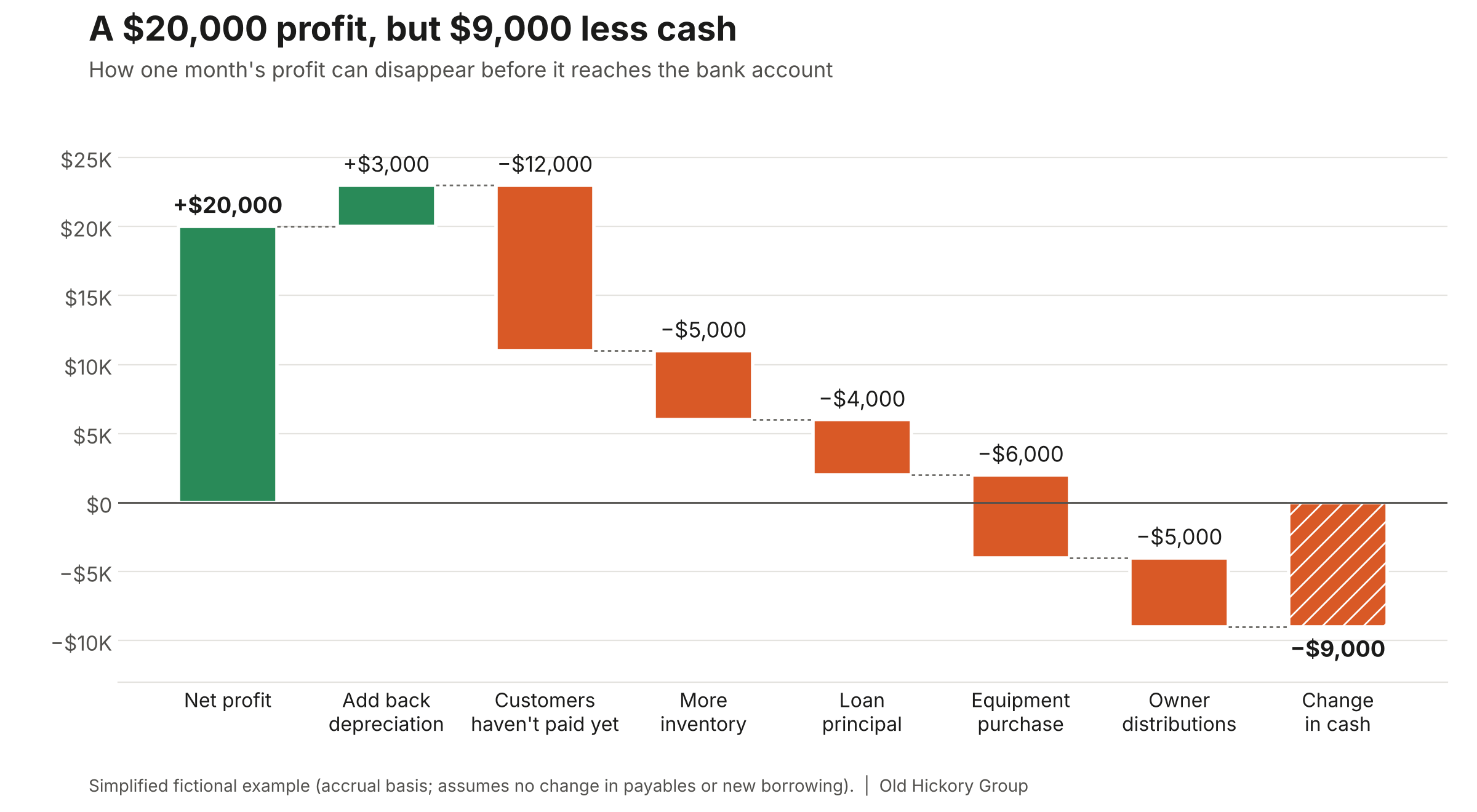
The business earned $20,000, yet cash declined by $9,000.
That result is explainable once you see where the cash went. It does not, by itself, tell you whether the spending was sensible or whether the pattern can continue.
This example is a simplified reconciliation, not a complete cash flow statement. Your own analysis should include changes in payables, other assets and liabilities, taxes, financing, and any other cash activity.
Look ahead before the next commitment
A rolling 13-week cash forecast helps you estimate weekly receipts and payments.
Include payroll, supplier obligations, debt payments, planned purchases, distributions, and taxes the business must pay or fund. Estimate customer receipts using realistic collection dates.
Update the forecast each week with actual results. When a gap appears, investigate its cause and timing. You may need to improve collections, change the timing of a purchase, adjust distributions, or evaluate financing.
Borrowing can address a timing gap, but it adds repayment obligations. Understand those obligations before relying on it.
Five figures to review every Monday
- Cash available today: Start with the bank balance and identify amounts reserved for collected or withheld taxes.
- Expected customer receipts: What do you realistically expect to collect over the next four weeks?
- Upcoming operating payments: What payroll, supplier bills, and debt payments are due over that period?
- Overdue receivables: Review amounts past their agreed terms, including invoices more than 60 days old.
- Other planned cash uses: What tax payments, equipment purchases, or owner distributions are approaching?
Avoid counting the same obligation twice. If a tax amount has already been set aside when calculating available cash, show its later payment against that reserve.
These figures are a starting point. Use them with the forecast to see when cash may become tight.[4]
Make cash part of your regular review
Review the income statement, balance sheet, and cash flow together. Each helps explain a different part of the business.
When an owner asks where the money went, I want us to get to a clear answer and then use it to make the next decision. A useful forecast gives you time to act before a payment is due.
Old Hickory Group helps business owners across Middle Tennessee turn financial reports into practical decisions. If your business shows a profit but cash remains tight, start a conversation about what is driving the gap and how to plan for the weeks ahead.
About the author: Phillip A. Jackson, CPA, CGMA, is a management consultant with Old Hickory Group in Murfreesboro, Tennessee. He has held C-suite roles and advises small and mid-sized businesses across Middle Tennessee on finance and operations.
References and further reading
- IRS — Publication 538, Accounting Periods and Methods
- BDC — How to manage working capital in a growing business
- Tennessee Department of Revenue — F&E-11: Threshold for When Estimated Tax Payments Are Required
- BDC — Techniques for better cash flow management
This article provides general information, not tax, legal, or accounting advice for your specific situation.