

The appointment book is full. Your team is working hard. Revenue is up. But when you look at the financial statements, profit hasn’t followed.
Before deciding the answer is more appointments, higher fees, or fewer staff hours, I would start with a question: What changed between the revenue coming in and the profit left over?
Industry trends make that question worth asking. Vetsource reports that visits declined in 2025 across its dataset of 6,451 U.S. practices while revenue edged up. Revenue growth can reflect higher prices even when patient volume falls. Your own reports will help you distinguish price changes, visit volume, and service mix.[1]
A full schedule tells you there is demand for your care. To understand the financial result, you also need to look at what it costs to deliver that care.
Follow the extra revenue
Consider a simplified, fictional monthly example:
| Measure | Earlier month | Later month |
|---|---|---|
| Revenue | $200,000 | $220,000 |
| Operating costs | $180,000 | $202,000 |
| Operating profit | $20,000 | $18,000 |
| Operating margin | 10.0% | 8.2% |
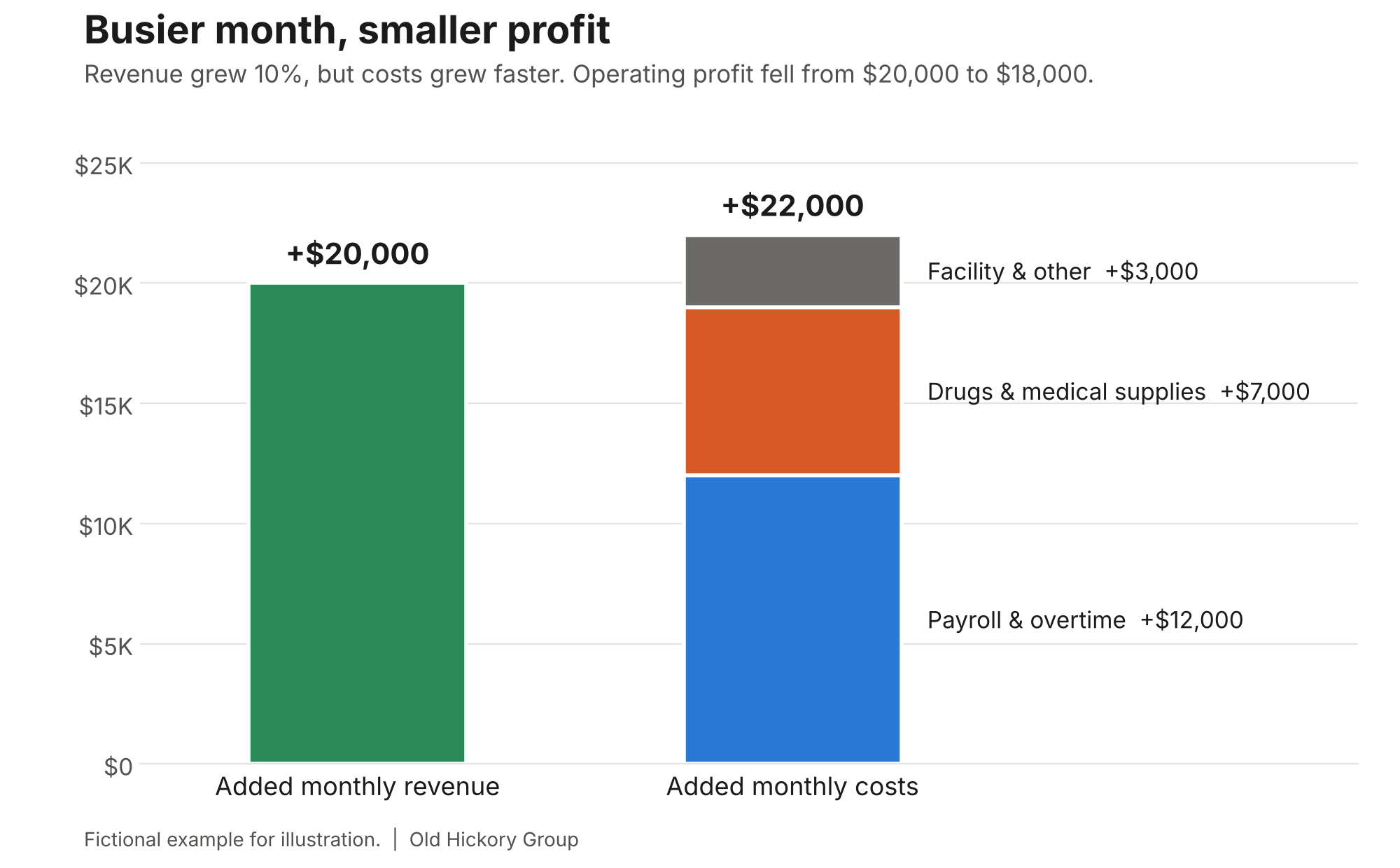
Revenue increased by $20,000, but costs increased by $22,000. The practice did more business and kept less profit.
In this example, the additional costs were:
- Payroll and overtime: $12,000
- Drugs and medical supplies: $7,000
- Facility and other costs: $3,000
Those figures are illustrative. Your practice may have a different explanation, and that is what you need to find.
Compare expense categories with recent months and the same period last year. A new associate, seasonal demand, or an unusual repair may explain a change. A recurring increase needs a different response from a one-time expense.
Consistent expense categories help. The AAHA/VMG Chart of Accounts provides a framework for organizing veterinary financial information and making comparisons more meaningful.[2]
Look at staffing and workflow together
A payroll percentage can flag a question. It rarely answers it by itself.
Look at payroll alongside appointment volume, hours worked, overtime, and how the team is deployed. Revenue per full-time-equivalent veterinarian, support staffing relative to veterinarian capacity, and overtime by role can help you identify where to investigate.
Higher payroll may reflect a sensible investment in compensation, retention, or growth. It may also reveal a schedule or workflow that needs attention.
Before cutting hours, ask:
- Are veterinarians waiting for exam rooms to turn over?
- Are credentialed technicians spending time on tasks another trained team member could handle?
- Are cancellations leaving gaps while overtime builds elsewhere in the week?
- Does staffing match your caseload and service mix?
The goal is to use the team’s time well while protecting patient care and avoiding unnecessary strain.
Check what each service contributes
Dental procedures, surgery, examinations, and pharmacy sales have different costs and demands on the team. Look at the fee collected alongside supplies, staff time, and room or equipment capacity.
Start with four areas:
- Fees: Have supplier cost changes been considered in your fee reviews?
- Charges: Do invoices accurately reflect the services and supplies provided?
- Inventory: What is expired, overstocked, or moving slowly?
- Discounts: Is there a clear purpose and approval process?
For missed charges, compare a small sample of treatment records with the corresponding invoices. You may find a documentation problem, an inconsistent process, or charges that are being overlooked.
Clinical recommendations should remain grounded in patient needs. The financial review helps you understand how to deliver that care sustainably.
Account for the owner’s work
You may work as a veterinarian, manage the practice, and own the business. Those roles need to be distinguished when evaluating earnings.
For management analysis, estimate reasonable compensation for your clinical and management responsibilities, taking care not to count overlapping duties twice. Then assess the earnings remaining as a return on ownership.
Otherwise, a practice that records little compensation for the owner’s work may appear more profitable than a similar practice paying for those responsibilities.
This is an analytical adjustment. How salary, draws, and distributions should actually be handled depends on the entity and its tax treatment.
Apply the same definitions when comparing periods or benchmarks. AAHA’s guidance emphasizes understanding how measures are calculated and using comparisons as one tool in evaluating a practice.[3]
A 30-minute starting review
With your reports available, set aside half an hour to identify the next question to investigate:
- How does revenue compare with the same month last year?
- What changed in payroll as a percentage of revenue and overtime by role?
- What changed in drugs and medical supplies as a percentage of revenue?
- Are active patients and new-client counts changing?
- Which expense categories increased faster than revenue?
- Does reported profit account reasonably for the owner’s work?
You do not need to resolve every issue in that sitting. Choose the largest unexplained change, assign someone to investigate it, and set a date to discuss the findings.
The owner-compensation question may need a separate review.
A full appointment book is valuable. Understanding what that activity produces financially helps you decide where to focus.
At Old Hickory Group, we help veterinary practice owners connect their financial results with the business behind the medicine. If your practice is busy but profit isn’t following, start a conversation about your practice’s financial performance. We can work through what is changing and what deserves attention first.
About the author: Phillip A. Jackson, CPA, CGMA, is a management consultant with Old Hickory Group in Murfreesboro, Tennessee. He has held C-suite roles and advises small and mid-sized businesses on finance and operations, with a specialty in veterinary practices.